A real-world example Of a future operations center
Throughout my career, I have been fortunate to work in organizations that operated under versions of McChrystal’s Team-of-Teams model. Between the Air Marshals, military, and private sector, each used a similar cross-functional framework: small teams working simultaneously towards their assigned missions, connected through an Operations Center that served as the central hub for shared information, operations, and communications.
Having worked across multiple roles within this model, including as an Operations Center Manager, I wanted to share my real-world experience of what a cross-functional Operations Center can look like in practice.
The services provided to the customer are irrelevant to this example. The focus of this article is the framework and operating model: how the teams were structured, the roles people played, how they communicated, and how the Operations Center connected them.
One important distinction I want to highlight is between a position and a role. Organizationally each employee held a certain position with a specific function or specialty. Operationally, they filled specific roles relevant to their position across different teams. This allowed people to move between teams without affecting the reporting and organizational structure.
The diagram below shows how those roles and teams were connected. This specific cross-functional Operations Center framework was built around the particular needs of the customer and the services we provided. The purpose is simply to show what Team-of-Teams principles can look like within a real-world Operations Center.
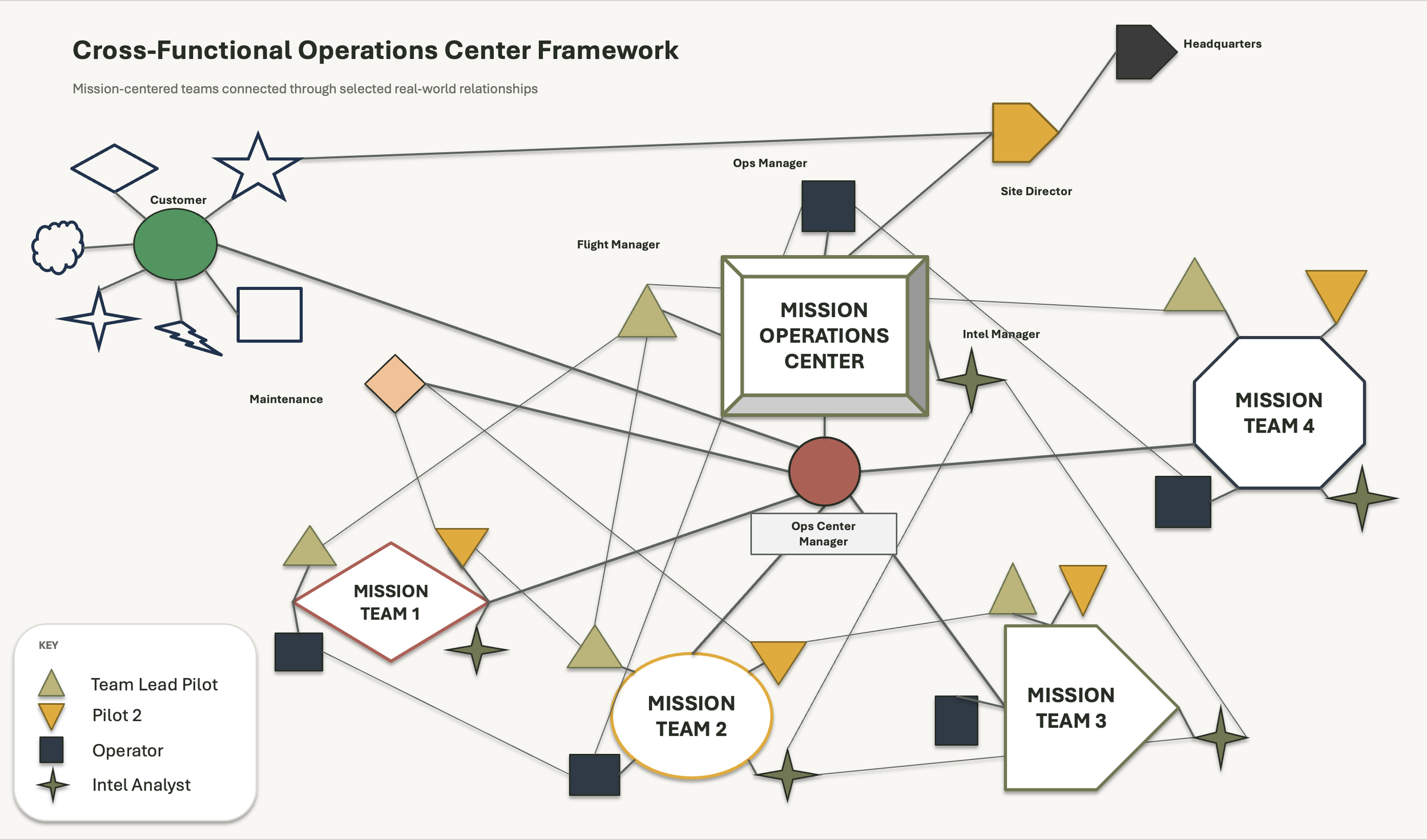
Bold lines represent direct communication to the Ops Center. Thin lines represent direct communication between teams or with managers.
OPS CENTER MISSION
Like many Operations Centers, the mission of this operations center was to serve as the central point of contact for operations and communications in support of the customer’s missions. The center operated 24/7/365, even if there were no operational teams (mission teams) working.
Multiple employees were trained to fill each role to a common baseline standard. Specific systems and processes during each shift helped maintain detailed documentation of all incidents and ensured continuity from one shift to the next so nothing was missed.
THE OPERATIONS CENTER TEAM
The job of the team that operated within the Operations Center was to maintain awareness, coordinate operations and communications, provide functional leadership and support, and connect the broader network. There were different positions within the Center, each with a specific role.
Operations Center Manager
The Mission Operations Center Manager served as the main POC for all operations. They prepared the Operational Teams with any pertinent information provided by the customer before they went out each day and managed ongoing missions and communications between all Operational Teams, the customer, and anyone else needed to quickly solve a problem.
Function Managers
The Flight Manager, Operations Manager, and Intelligence Manager oversaw the people from their respective functions working across the different Operational Teams. They maintained schedules, helped solve any in-depth technical problem during missions, mediated internal team conflicts, and worked closely with the customer to facilitate specific needs or requests. Sometimes they would move from the manager role to an operational role when additional support was needed.
Site Director
The Site Director managed “Heads and Beds,” or the facilities and people side of the site. This included housing, site facilities, and coordinating with local partners. They were mostly hands-off with daily mission operations but sat in the Operations Center because they maintained awareness of what was happening across the site and served as the main connection between the site, company Headquarters, and customer leadership.
TEAMS OUTSIDE THE OPERATIONS CENTER
Not every team or role operated within the Operations Center, but they remained connected to the Center and supported the overall mission in different ways.
Operational Teams (Mission Teams)
Separate from the Operations Center Team were the Operational Teams that went into the field to execute "the mission", or services the business was there to provide to the customer. These can also be referred to as “Mission Teams.”
Every day different teams would go out to support specific missions which were set by the customer. Teams were comprised of four different people, each filling a different role respective to their specific function. Any qualified person from that function could fill the role, allowing the makeup of the team to change from mission to mission.
Maintenance
Maintenance operated as its own team outside of the Operations Center but played a massive role in daily operations. They remained closely connected to the Ops Center and Operational Teams to help quickly resolve mechanical or technical problems.
Company Headquarters
Headquarters functioned as the Executive Team. They were mostly removed from daily operations but maintained awareness through daily/weekly meetings with the Site Director and Function Managers.
COMMUNICATIONS
For the most part, all operational communications ran through the Operations Center, specifically the Operations Center Manager. Each member of the Operational Teams also had a direct line of communication to their respective Function Manager in the Ops Center.
The Center maintained multiple means of communication:
Chat software
Multiple radios, including satellite radio
Two different email platforms
Multiple Ops Center phone lines that Operational Teams could call directly from their field computers
A satellite phone for extreme emergencies
Most communications happened through chat software that was similar to Discord or Slack on the civilian side. Chats connected the Ops Center with every team and individual team member, while also allowing Operational Teams to communicate directly with each other. The system also connected the Ops Center and Operational Teams to the customer, Maintenance, and other regions. Each member of the Operations Center monitored multiple chats at any given time.
The benefit of multiple lines of communication was that they helped maintain shared situational awareness and gave teams different ways to quickly solve problems. If one team was having a mechanical or technical problem, they could reach out to the Ops Center Manager, Maintenance, or someone from another team for help. If there was a threat to the team, that information could be disseminated across multiple channels just as quickly.
OPERATING AT SCALE
Now that you have a basic understanding of how this cross-functional Operations Center framework was structured, I want to introduce another layer for those of you working at large or multinational corporations.
The company I worked for was a large multinational corporation. This program was one of many within the company and provided the same service to multiple customers across different locations. Each site had its own Operations Center and operated under the same basic framework.
I was also part of a team tasked with leaving one region to set up a second region for a new client. That included designing, building, and setting up the Operations Center.
The size of each site varied based on the level of support required. Some sites needed multiple people filling the same roles at the same time. For example, one site had twice the number of Operations Center Managers working at once because of the level of support required.
Just as teams were connected within each site, the Operations Centers were also connected across sites. This created a larger network where information, resources, and support could move between locations when needed.
The diagram below illustrates how the same framework expanded across multiple locations and customers.
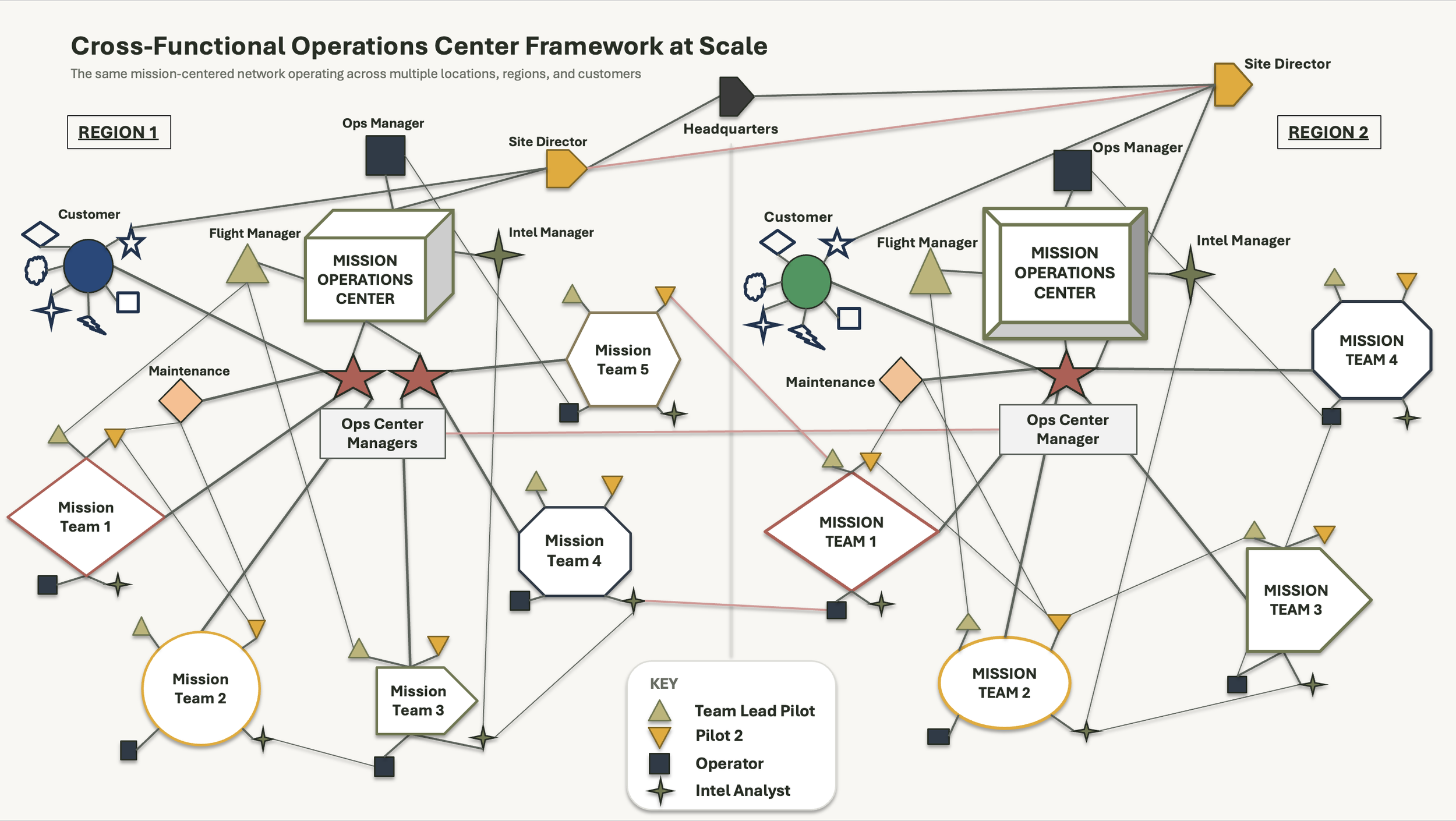
Again, bold lines represent direct communication to the Ops Centers. Thin lines represent direct communication between teams or with managers. Now, red lines represent communication across sites/regions.
WHAT COULD THIS LOOK LIKE WITHIN A CIVILIAN COMPANY?
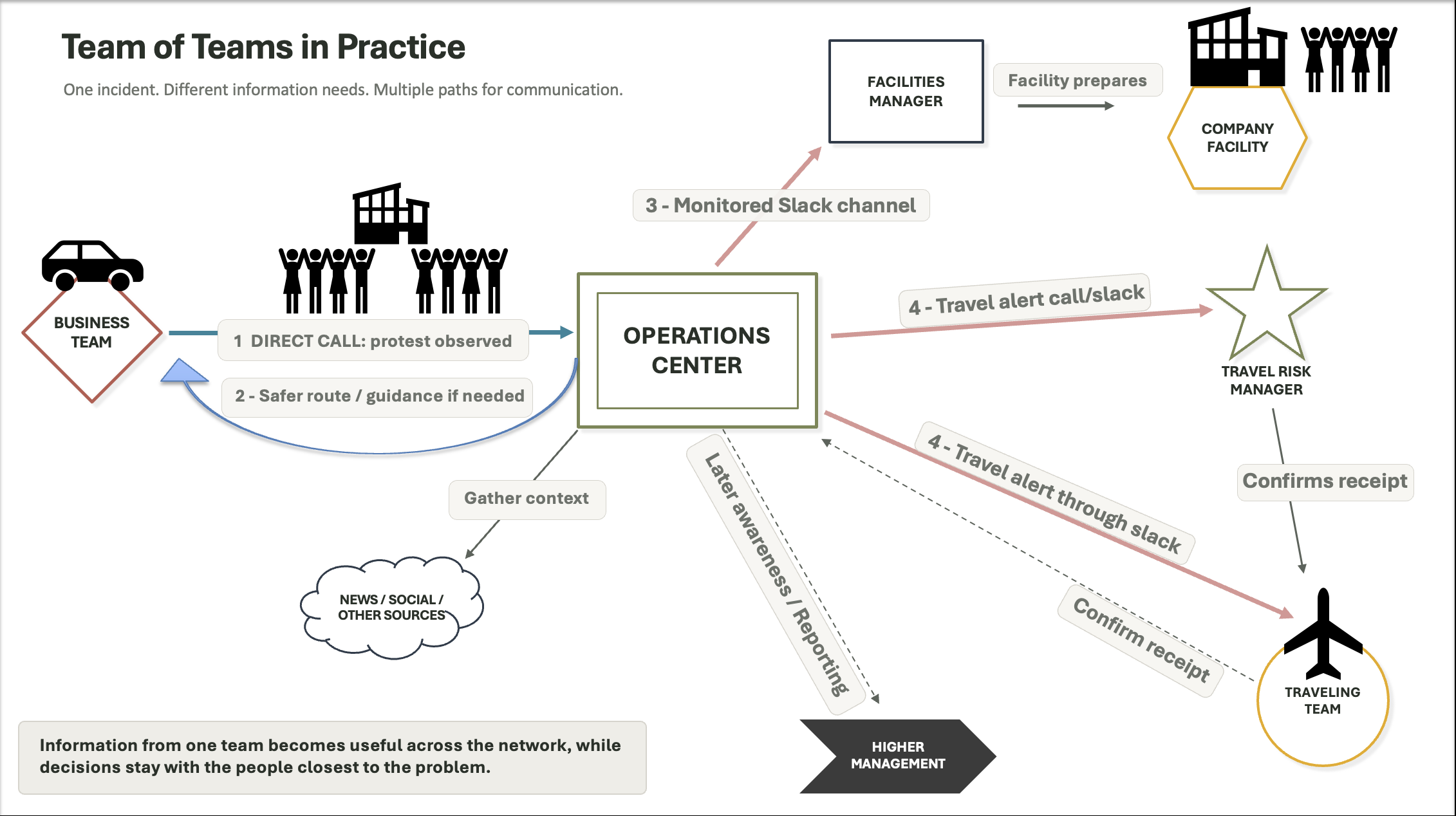
Imagine a business team returning to the office after an off-site meeting when they notice a protest forming near one of the company's facilities. The team reports it by calling the Operations Center directly.
The Operations Center then:
Assesses the situation: Gathers additional information and determines who across the organization may be affected.
Supports the team: Helps the reporting team identify a safer route back to the office.
Alerts the facility: Notifies the Facilities Manager through a monitored Slack channel or a direct phone call so the nearby facility can gain awareness if not already aware.
Looks ahead: Recognizes that another team is returning from a business trip within the hour and pushes the information straight to the team as well as to the Travel Risk Manager.
Confirms receipt: Stays in contact with Travel Risk to confirm the returning team receives the information after landing.
Keeps decisions decentralized: Higher Management does not need to become involved if the teams and functions closest to the problem can manage it. Depending on company policy, leadership can be made aware later through a daily report or routine conversation.
This simple example demonstrates all four principles of the Team-of-Teams framework. A Common Purpose gives everyone a shared understanding of what the organization is trying to accomplish. Trust allows information and responsibility to move between teams and functions. Sharing information across the network creates Shared Consciousness, while Empowered Execution allows the people closest to the problem to act without unnecessarily pushing decisions higher in the organization.
Hopefully this article gives you a better idea of how Team-of-Teams principles can work within a real-world Operations Center.
This was one framework built around a specific organization and operational need. The exact structure may look different for every company, but the concept remains the same: connect teams, establish clear roles, create multiple paths for communication, and give people the ability to share information and solve problems quickly.
I am grateful to be part of the team standing up the Future Operations Center Group and hope this example helps as we continue exploring what the next generation of Operations Centers could look like.
If you have any questions or want to discuss the framework further, feel free to reach out here, on LinkedIn, or through my website.
Due to the sensitive nature of the work, I cannot discuss any specifics about the customer, missions, or organization beyond what is included in this article.