Traveling for school? Whether for study abroad, research, athletics, service, or another academic program, being prepared for a trip means connecting the dots to the unknowns before you leave.
Travel resilience is your ability to prepare for, respond to, and adapt when something doesn't go according to plan while traveling.
This checklist is designed to help you think through questions that are easy to overlook before you travel: How will you communicate if your phone doesn't work? What happens if you lose your ID? Where are the important locations you may need during your trip? Who needs to know if your plans change?
The goal is to make sure you aren't figuring everything out for the first time during an emergency.
Use this article to learn before you travel. Then download the PDF version of the checklist to take with you digitally. You can also download a free information template so you can fill in all the important phone number’s, addresses, or other information as a hard copy. (Don’t worry, you’ll learn why the more you read.)
Whether you're a student preparing for study abroad or a parent helping your child prepare for a school trip, go through it and make it work for you.
01 | PACK FOR THE UNEXPECTED
Think about packing in layers: what stays with you, what stays close, and what can stay in your main luggage.
👜 KEEP WITH YOU
These are the important items that stay on you, even when you put down your backpack or luggage. A small crossbody bag, fanny pack, purse, or secure pocket can work well.
📱 Phone + Charging cable / charger
🪪 ID / passport
💳 Money / payment card
💊 Essential medication
📇 Important contact information
Keep it simple. These are the things you don't want to be without if you become separated from your group or belongings.
🎒 KEEP CLOSE
Think backpack or small carry-on—something you can keep nearby and grab quickly.
🪪 Copy of your ID or passport
👕 Change of clothes
🩹 Basic medical / first-aid items
💧 Water bottle
🔌 Backup charging cable / charger
🔋 Portable charger / power bank
🌍 Electrical plug adapter for international travel, if needed
🎒 Other important personal items
🧳 MAIN LUGGAGE
Use your main or checked luggage for clothing and other items you don't need immediate access to.
OTHER CONSIDERATIONS
DOCUMENTS & MONEY
📄 Bring the ID and travel documents you need.
🪪 Make copies of important IDs or your passport and keep them separate from the original.
💵 Keep a small amount of backup money or a second payment option separate from your primary wallet.
🌎 International travel: Talk through how you'll access money and use local currency. Don’t forget to tell your bank you’ll be traveling.
HEALTH
💊 Pack enough required medication for the entire trip.
🩺 Make sure the appropriate people know about important medical needs, allergies, or medications.
🏥 Know who to contact if you become sick or injured.
REMEMBER
Don't keep everything important in one place. Keep copies and backups separate. If something gets lost, you still have another option.
02 | HAVE A COMMUNICATION PLAN
Your phone will probably be your main communication tool while traveling. Set it up before you leave—but don't make it your only plan.
📱 SAVE YOUR CONTACTS
Students should have contact information for:
🏫 School / program emergency contact
👩🏫 Teacher / coach / chaperone / trip leader
👪 Parent / guardian / emergency contact
🧑🤝🧑 People they're traveling with
🏨 Hotel / lodging
📄 Create a backup: Save these contacts in your phone, but also print or write down the most important names and numbers. Keep the paper copy somewhere separate. You can download a free information/contact form template below. Fill it in, print it out, keep it on you.
STAY CONNECTED
💬 Start or join a group message for the trip or travel group.
⭐ Star or pin important messages so they can be found quickly.
🕐 Know when and how you're expected to check in.
📍 Let the appropriate person know if your plans or location change.
🔋 Keep your phone charged and carry a portable charger when possible.
REMEMBER
Your phone may be your map, wallet, communication tool, and source of emergency information. Have a plan for functioning without it.
If you are traveling internationally:
🚨 Know important emergency numbers for the country you are traveling: 9-1-1 is not a worldwide emergency number.
🌍 Know & understand how different country codes work. For example: +49 vs. 049 in Germany.
03 | KNOW WHERE YOU ARE
BUILD YOUR TRAVEL MAP
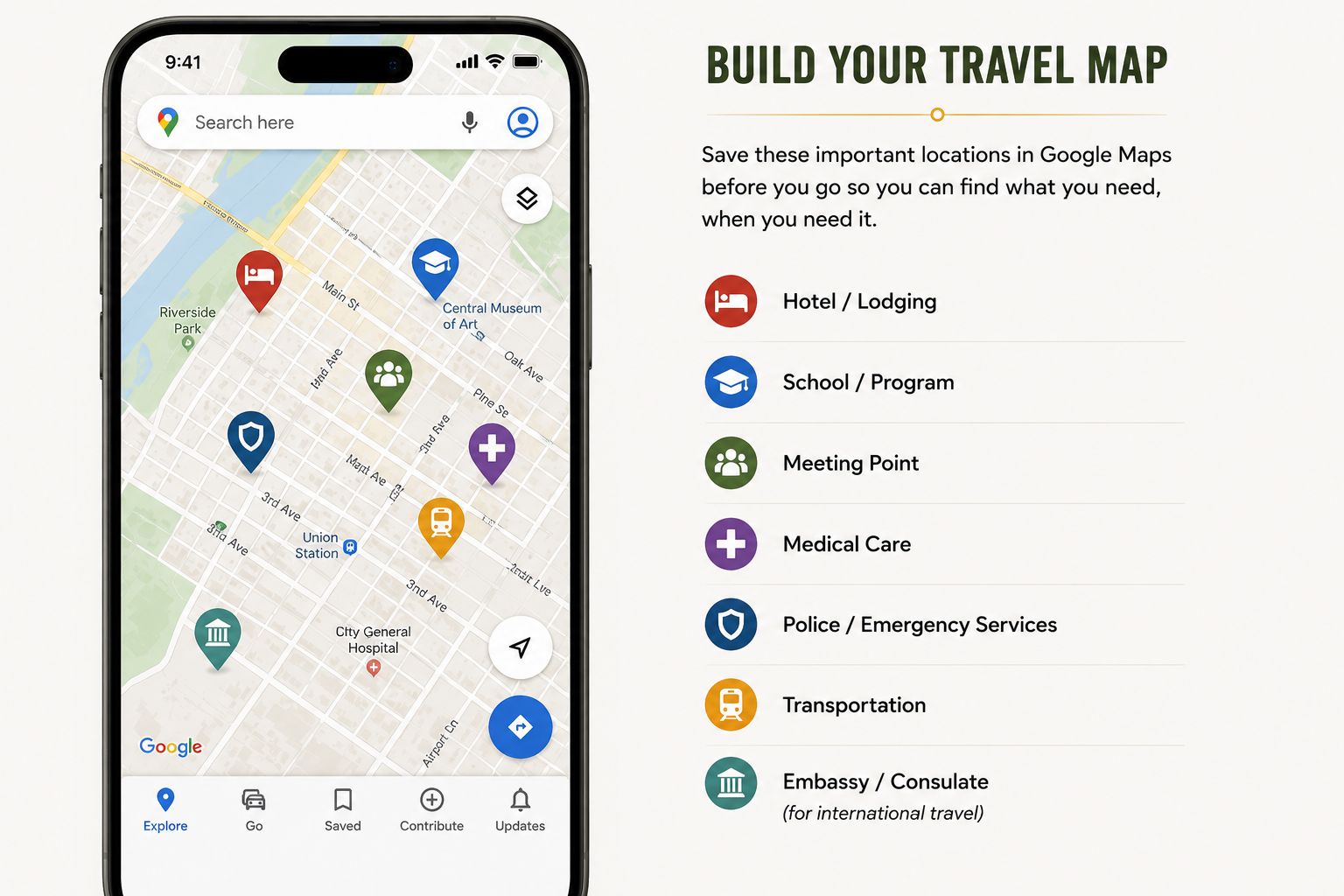
Maps aren't just for directions. They can help you understand what's around you, store important information, and quickly find where you need to go.
Before you leave, use Google Maps or another mapping app to save important places for your trip and store information about that location in the notes of the pin. You can also share your saved locations with others.
MAKE YOUR MAP WORK OFFLINE
⬇️ Download the area for offline use before your trip.
📌 Save your important locations before you leave.
🧭 Know how to find your lodging and meeting point on the map.
📲 Share useful locations with your parent, guardian, travel companions, or group when appropriate.
MAKE YOUR PINS USEFUL
Don't just drop a pin. Add the information to the notes section you may need when you get there.
Use notes or labels within your saved locations for phone numbers, meeting instructions, contact names, or other useful information.
Some information might seem redundant when you have the map there, but you can’t always count on technology to work when and how you want it to.
Notes Example:
🏨 HOTEL / LODGING
Hotel Name
Address: 123 Main Street
Direct phone number to the front desk: +1 555-555-5555
Meeting Point: Main Entrance
Emergency Meeting Location: Behind the hotel in the Church parking lot across the street
Trip Leader: Name / Phone
OTHER TOOLS
Consider using other apps, like Life360, to help keep track of your students location. Having situational awareness goes both ways. The student should know where they are and how to get around, but parents and teachers should also have awareness of where that student is if needed.
REMEMBER
Knowing where you are gives you options. Your map can help you navigate, communicate, and make better decisions when plans change.
04 | BEFORE YOU LEAVE: HAVE THE DISCUSSION
Every trip is different, and so is every student.
Younger students may work through these questions with a parent, guardian, teacher, or trip leader. Older students traveling independently or studying abroad can have the same conversations with roommates, classmates, or the people they're traveling with.
TAKE FIVE MINUTES AND TALK THROUGH A FEW SIMPLE “WHAT IFS”
🧑🤝🧑 What happens if we get separated?
📞 Who should I contact first?
📵 What happens if my phone doesn't work?
🏨 How do I get back to where I'm staying?
🚌 What happens if transportation or plans change?
🪪 What should I do if I lose my phone, money, or ID?
📂 Does everyone know where the important information is stored?
REMEMBER
Talk through the “what ifs” before you leave. If something changes during the trip, you'll already have an idea of what to do next because you’ve had the conversation before.
TAKE YOUR PLAN WITH YOU
Phones die. Service disappears. Plans change.
Download the free My Travel Information & Backup Plan to keep your lodging information, important contacts, meeting point, emergency information, and backup plan in one place.
Fill it out before you leave. Save a copy on your phone and keep a printed copy with you.
Get The Student Information & Backup Plan!
PREPARED TRAVEL STARTS WITH A PLAN
A checklist is only one part of student travel preparedness.
FOR SCHOOLS & PROGRAM LEADERS
Effective student travel programs establish clear responsibilities, communication and escalation protocols, risk assessment processes, emergency response procedures, traveler education, and opportunities to learn from each trip.
FOR PARENTS & FAMILIES
Preparedness starts with understanding the school's plan, talking through the “what ifs” with your student, and making sure everyone knows how to communicate if something changes.
Boreal Global Solutions helps schools build practical student travel programs and works with families to develop communication and emergency plans based on their specific travel needs.
BOREAL GLOBAL SOLUTIONS
This checklist is intended as a general preparedness resource. Not every item will apply to every traveler, school, destination, or type of trip. Students and families should follow the requirements and guidance provided by their school or program.